RagPiano.com - Guide to Ragtime and Old-Time Resources
As you look through this page, please keep in mind that a great deal of work has gone into what I do, and what other artists have contributed to ragtime performance and the advancement of the knowledge of this indigenous American music. With that in mind, know that your input is invaluable to any of us. Also, know that your patronage of any of us that have recordings or music for sale well help perpetuate future high-quality reference sources.
Thank You 
Sourcing Ragtime Music - History
Often when I perform, one of the questions that has been most asked of me, other than "Can you play Deep in the Heart of Texas and take the piano with you?", is about where I am able to find the wealth of material that I'm able to present. Without intentionally duplicating anybody else's effort, I hope to present at least a primer here that answers that very question. I started collecting ragtime music in the late 1960s (yes, I was very young... very!) and at that time the resources were scant. There were several reasons for this.
- The second "Ragtime Revival" was just beginning, so interest was still light.
- Much of the music had never been collected into an organized format.
- Even more of the music was not known to be collectible yet as demand had not risen to the level of supply.
- A great deal of the music was not in circulation, and would be disseminated largely through estate sales as their owners and/or heirs would die.
- New discoveries were still coming to light, as evidenced by the fact that They All Played Ragtime was still being updated, and Silver Swan (presumably composed by Scott Joplin) had just been discovered.
- Ragtime piano, in particular, was highly regionalized, so with the exception of a handful of popular rags, they were rarely available outside of a specific publisher's sales area, which may include several states. Songs generally saw much wider distribution.
- A great deal of music was still under the 78 year copyright restriction (now extended), and not in the public domain, so inclusion in a folio or as a single sheet was an often expensive proposition.
A good example of the latter problem involves the release of the
Vera Brodsky Lawrence edited version of the rags of Scott Joplin, which initially was called the "
Collected Works" (Vol. 1, as Vol. 2 contained the songs with lyrics and the score to
Treemonisha).
Jerry Vogel, the single copyright holder for
Searchlight Rag,
Rose Leaf Rag and
Fig Leaf Rag was not amicable to releasing the copyright at the time of publication (1971).
The "Collected Works" of
Scott Joplin, 1971.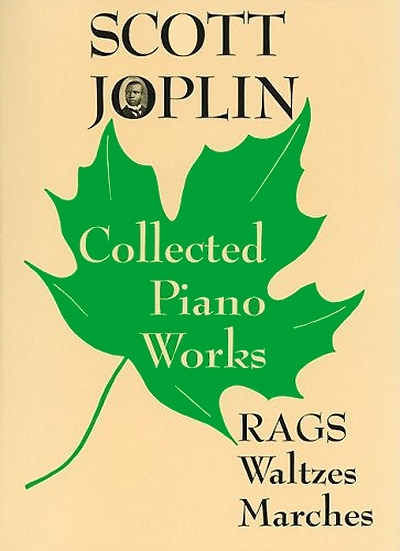 |
As told to me by to historian
Edward Berlin, he did not want to simply give the rags to the project, but wanted some form of compensation for publication rights, as he was still publishing the pieces in sheet music form, which was a fair request from a business perspective. It is possible that he was never offered compensation as such to his liking, but his sales for those three pieces thrived as a result of the other publication. So there are two distinct sides to that story. When Vogel died in 1980, his family released the rights (they were about to enter Public Domain anyway), and the book was re-released as the "
Complete Works". Even now, much of the material that has become available in collections in the 21st century had been released from copyright restriction in 1998, meaning pieces dating to 1923 and later are still under copyright protection due to the so-called Bono/Disney legislation in the U.S. Congress in 1998.
Now, with the Internet and other electronic resources at our disposal, access to many of these pieces from 1922 and earlier is much easier. I will do my best to not only present sensible and easy sourcing, but to update this page whenever necessary. Understand that by necessity, some of the sources here will be links to more detailed linked sources, rather than directly to the large number of growing resources directly. Comments and additions are always welcome (see below).
An additional note to this section on pricing. Over the past two decades, many of you have asked me how I ascertain prices and why many pieces seem to be much higher in estimated value than they used to be. I use a combination of factors, including what I or my peers have paid either on-line at auctions or at antique malls/shops, and the books like those of
Marion Short that have pricing within, adjusted for inflation and changes in buying patterns since publication.
The original edition of
Maple Leaf Rag.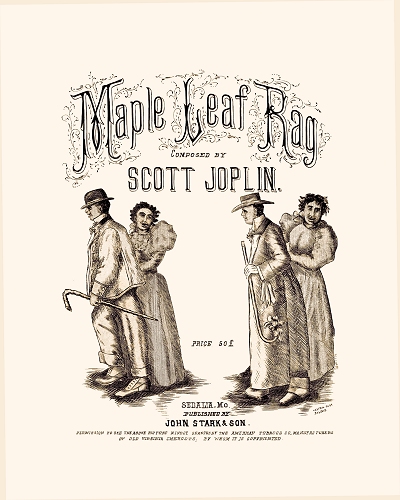 |
A development that is both flattering and mildly alarming is how ragtime sites such as mine have actually impacted pricing, particularly on
eBay. In the early 1990s, pieces like
Lion Tamer Rag or the
Pastime Rags were rarely heard by the average ragtime collector or enthusiast, and were therefore easier to obtain at single-digit prices. The exposure given these pieces by the few ragtime sites that post them, particularly those with cover images, has raised the demand because musicians and other buyers now have a better idea of what they are getting. The author finds himself quoted quite often in
eBay, with a reference to some recordings that are on his site. It was not my intent to create this phenomenon, as I also occasionally suffer the consequences when looking on-line for items of interest to purchase. It is even worse when the bids suddenly rise because of a certain few bidders like myself who show interest in an otherwise obscure piece, although since eBay started hiding identifications during bidding this has changed to a degree.
The best bet is still out there on the road in the little shops or the out-of-the-way antique malls and other places listed below. For example, in early 2015 an original Sedalia edition of Maple Leaf Rag, of which only 200 were printed and four were known to have been extant, surfaced in a music shop in Saint Louis, Missouri, bringing the total of known copies to five, years after the last one was found. (It now resides at Scott Joplin House in Saint Louis.) The on-line price peak seems to have been reached around 2007 to 2008 or so for the time being, even now as we are coming out of a protracted recession. However, some auction pieces are still a bit overpriced for the average collector, and for that I apologize for whatever impact my colleagues and I have had on this. There are still good deals out there. You've just got to channel your passion into the effort to find them.
BILL'S TIPS FOR SOURCING MUSIC
- Make friends with a dedicated musician, preferably one who has eccentric tastes. They are usually more than willing to share pieces of their collection. They are also more likely to know your taste, or suggest a few tunes. As for the eccentricity, this provides an increased possibility of discovering great tunes that might have otherwise gone unnoticed. You could also follow the links I have on most of these pages to other ragtime musicians and write to them. They should gladly respond to any reasonable request that does not violate copyright laws.
- Don't discount old records and tapes as good sources. If one song out of ten on a record is good, then it's probably worth the purchase. Transcribing or copying is not all that hard for someone with basic musical training. In addition, you get a chance to hear the pieces and peruse them beforehand. This also applies to player piano rolls, if the necessary player piano is available to you.
- Libraries in both small and large cities contain many surprises. Don't just look on the shelves though; try the stacks, or get permission to look through rare or stored material. The Library of Congress has a loan program with many municipal libraries, and will often send out materials or copies (or even microfiche printouts) of pieces. The Smithsonian American History Museum is currently working on a similar program with a large private collection, which would place images and/or MIDI files of rare music on-line.
- Get a reference book of songs or rags (some are listed on my Books on Ragtime page). These contain titles, composers, recordings, and occasionally the current publishers of pieces and folios.
- Visit your parents or grandparents, or friends thereof, more often. Offer to inventory or clean their attic or other storage area. If anyone in the family was ever a musician then many surprises may await you. I obtained some of my earliest acquisitions as well as musical instruments in this manner.
- Many small towns have historical homes or buildings that contain private music collections. Browsing, and sometimes, copying or scanning privileges are usually obtainable if sought in earnest.
- Look for antique stores, antique sales in the paper, and listings of estate auctions. On occasion, you may end up buying a reed organ for $50, or a box filled with oodles of rare sheet music for around $10-$50. As for the stores, try those that are not on main thoroughfares, and in some antique malls. About one in ten antique stores and two of three antique malls will have some old music, often in large format. Here's a better hint: Some of the best bets are usually discovered in stores specializing in old books.
- Look for standard sources in catalogs or in music stores. The best source of older music had been and is still Dover Publications, as listed my Ragtime Music Folios page. However, there are many other collections available in print. This is an inexpensive way of obtaining a good library of standard and lesser-known pieces with only a modicum of duplication and financial outlay.
- Utilize the many sites and archives which universities, libraries, and even people like myself have laid out on the web. If you are a good listener, or have the proper MIDI sequencing program, you can easily decipher MIDI files for notes, and listen to them for style. There are also an increasing number of sources that have printable .JPG or Adobe .PDF picture files of music, many of which are listed below.
- A hint about search engines. While my favorite (since 2000) remains Google.com, usually returning the most complete results, most of the other major search engines can do a decent job of narrowing down what you are looking for if properly utilized. You can either use their advanced capabilities, or learn how to enter a relevant search. The best tip is to search on phrases, such as song titles, by enclosing the phrase in quote marks. (Make certain that you are sure of your spelling). This instructs most of the engines (there are a couple of exceptions) to search on the exact phrase rather than just for the inclusion of each word in the phrase in a particular site. You can also use the + and - signs to explicitly include or exclude something from a search. For example, "weeping willow" +wenrich -joplin will search for sites that contain Weeping Willow by Percy Wenrich and have no mention of Weeping Willow by Scott Joplin. Adding words such as MIDI, lyrics, composer, etc., can further narrow down searches for better relevance. Learning these few tips will increase your odds of finding what you are looking for in less time, and will answer most of the frequent questions sent to me concerning finding items on the internet.
- Consider an investment in a 10.1" or larger tablet, such as an iPad or Sony Xperia. Most have relatively generous storage capabilities, and you can build your own catalog of pieces from archive sites or PDF scans done by friends. There are many fine programs designed to manage these, even allowing sorting and continuous page turning. With these tools you can make your own dream folio.
Note: Remember not to discount old-time songs as well as ragtime. If entertainment is your goal, then remember that many people are just as or more entertained by these than by piano rags because they can participate (quietly or otherwise) with the performer, enhancing the experience for each listener. But, to make the songs interesting, try to find the original sources so you can include the verses, and occasionally make corrections to melodies that have often been altered through public dissemination over the years. Oh... also make certain that you do an honest assessment of your singing ability and vocal salesmanship skills. Trust Me On This!
Remember this suggestion when listening and learning what you have sourced: Try to develop your own style, even if it is a conglomeration of all those who influence you. I can play exactly like
Paul Lingle and
Joshua Rifkin. I can even imitate the licks of
Lou Busch and
Butch Thompson. It is an affable imitation of someone else, but it is not me. When I integrate these and create new ideas from my creative side, what comes out is "purely 'Perfessor' Bill." So, be original, but don't be afraid to lift good ideas where they occur - just make them your own! It's not plagiarism; it's simply research. For more detail on this, see my article on
Playing Ragtime.
Additional Web Resources
A huge inventory of covers for display in varying categories, mostly from the 1820s to 1922, and many with downloadable images of the music as well. Recently underwent a major upgrade including better presentation, larger images and PDFs for many pieces. This is the original on-line archive, and still one of the best historically.
Duke University has a nice inventory of selected sheet music categorized by decades from the 1850's to the 1920's, with images of the covers, music, and ads in various sizes for viewing or downloading.
A fine collection of music associated with Colorado and a great selection Ragtime sheet images. Includes some Euday Bowman originals.
This is a vast multi-library resource that covers parts of Indiana University not seen in their standard collection, and takes in Indiana Historical Society and other libraries as well. Good for research, even though not all sheets have associated images.
This site, home of the Charles H. Templeton Sr. Music Museum, has grown incredibly since it was launched, with more to come. Beautiful design, and lots of ragtime goodies. The basic search engine works well, and the advanced search could use some work. There are additional helpful resources on the site, which Charles Templeton Jr. assures me is one of his priorities and clearly the pride and joy of his late father.
This fine collection has become quite expansive with many items found here that aren't elsewhere. Very good source for items that were included in early stage musicals, and nice resource for research as well.
An exciting addition to the many on-line archives, there are some very unique items that are to be found in this collection. The single drop-down title page is a bit more difficult to navigate, so the browse by composer pages (linked to here) are recommended. Just select Music from the list and Go.
A large multi-tiered archive with some standards as well as four to eight hand arrangements, hosted by the University of Maine libraries. There are several ways to search, and good keyword use or filtering by years are recommended to minimize results.
Baylor University has one of the newer web-based collections available, which is fun and worthwhile to browse through for researchers or casual users. Many of the sheets are in digital printable format.
Presented with the Detroit Public Library, this important collection includes full scans of many pieces of African-American music or that with Negro Themes, and is invaluable for research on composers like Fred S. Stone, Eubie Blake or Bert Williams among others.
This collection lives at the University of South Florida. It is a great reference for years of publication and publishers, as well as composers.
While mostly not available due to copyright restrictions on many of the items, this collection still has some very unusual items that make it a great research tool, or perhaps confirmation for the existence of rare pieces. UNT also houses the great Stan Kenton library. Keep refreshing since this one times out after a few minutes.
A nicely organized and visually rich archive of African-American based music from 1850 to 1920, and worth a lengthy browse into its treasures.
A substantial cache of nearly 20,000 scanned sheets dating back to the 1850s, as collected by Howard W. Wildin. Hard to browse through because of the size, so be prepared to either search or spend a long time browsing.
The Cleveland Library Consortium is a good reference point for Ohio ragtime and beyond, and is involved with exchange or temporary lending programs with most U.S. libraries. So what you find here can often be borrowed or copied for research.
A well categorized collection acquired by the Smithsonian Institution, this focus largely on the images and how they reflect the American way of life. Images are few, but can be viewed at the American History Museum in Washington, D.C.
A sizeable collection of over 7,000 music sheets, with many unusual ones tied to California history along with the expected fare found in many piano benches. Well-scanned and documented.
Great reference site for listings recordings of ragtime and other music as well as research on composers and what they wrote. Scores can be made available through local college/university library lending programs.
Over a century of sheet music and some extraordinary engraved and lithographed covers mixed in with the usual expected content found on archive sites.
The Library of Congress section devoted entirely to ragtime. You'll find rarities by many composers including original transcriptions easily downloaded for your perusal.
One of the better references, albeit without on-line images at this time, of works published in and around Kansas City, including a lot of Charles L. Johnson pieces and items from the Jenkins and Hoffman catalogs. This makes for a fair research site on Missouri composers.
This school hosts the small but interesting Alvah Sulloway Sheet Music and Theater Program collection that goes beyond the ragtime era, focused in some respects on theater. Another good research tool with the occasional rare find, particularly in some of the programs.
Ragtime and other music from Down Under. This is an interesting resource that features not only music unique to Australia, but many imports from the U.S. and elsewhere as well. Search on "Rag" or specific composers or titles.
There are a surprising amount of great resources and references that include sheet music in this library archive, worth a look when trying to search for more information on any particular composer.
Ted Tjaden has assembled this site focused in part on his native Canada and on the music in general. Includes many scanned images of original sheet music and links to many more, plus excellent articles and information on rags, genres, composers, etc.
Covers and accompanying MIDI sequences for music from the 1800's to the 1940's. A very well balanced and represented collection with a good archive.
Hosted by noted piano technician and historian Art Reblitz, this site not only features his marvelous and detailed book on mechanical music instruments, but has many articles on the history of such machines and the companies that built them, along with other highly useful information and links related to the topic.
This well-known stop is a good source for much of the ragtime and traditional jazz currently in print, as well as lots of used material that is hard to find. Search on
Ragtime Music
Dover has the best of the best of ragtime folios as well as many other genres and categories of historical interest. Search on ragtime or follow the music links.
Owned and operated by delightful pianist and Bill's good friend Richard Dowling, this store is a one-stop shop for virtually any of your sheet music or folio needs, be they classical, ragtime, or instructional. Many other fascinating items to be found here as well. Highly recommended, and reliable.
This on-line store has a large selection of ragtime music in both print and downloadable forms. From the following link you can see their
Ragtime and Jazz/Blues Sheet Music selections.
Fairly good selection, although some of the better known Dover editions are buried, and the searches are not as focused as may be desirable within such a limited spectrum. Worth a look, though.
A European site with digital scores requiring Scorch. Some of the scores they are charging for ($5.79 for Maple Leaf Rag?) are actually available for free from on-line archives, but some arrangements of rags are also accessible to less-skilled players.
This site has a good-sized selection of some music that is hard to locate in other places. You will have to do some mining to find what you are looking for, but you may turn up som gems.
A general purpose resource website related to piano performance, sheet music, information, and 300+ year history of the beloved instrument.
This site vast resource of MIDI creation software and equipment, pre-recorded MIDI files, a large inventory of music books, and much more.
This site allows you to download selected scores to your computer for printing. Covers everything from classical to current styles, including ragtime and jazz, for a variety of instruments as well, and sometimes in a requested key.
Within is one of the best online music stores (formerly Sunhawk.com), covering all styles of music, including many titles in the ragtime/old-time genre with legal digital downloads that you can print directly. This includes virtually all of the works by Scott Joplin. Search on "ragtime" or by title or composer. Many include MIDI files and can be transposed quickly, plus some have tab and/or chords.
This company specializes in hard to find or out of print books. Search on Ragtime or the specific book title. Since many of these books are rare but in good condition, expect to pay a premium for ownership.
A combination of sources combined into one location, you can search on multiple categories, including rag, and purchase scores for piano or more instruments, many from eBay buy-it-now links. At the very least, it can fast-track some of your searches for many items.
I always welcome your comments, questions, corrections, and/or requests for further information or additional resources. I also will be glad to engage you in discussion about these topics if you want to mail me directly on

. Also take a quick look at my
FAQ page to see if your question might be answered there. Thank you so much. Remember that I can't respond to you without your e-mail address, and be CAREFUL to enter it CORRECTLY or no response will be forthcoming. This will only frustrate both of us. I will NEVER SPAM, so consider it between us only.






 Loading Page. Please Wait...




































 Click here for more space
  Click here to expand menu


 Baylor University Library
 Digital Music
 Ohio State University Libraries
 MIDI-Classics