In the last decade of the 19th century, the American economy, and to some extent the world economy, suffered a mildly crippling depression that remains second in scope only to the devastating financial crisis of the early 1930s.
An example of early Greenback currency.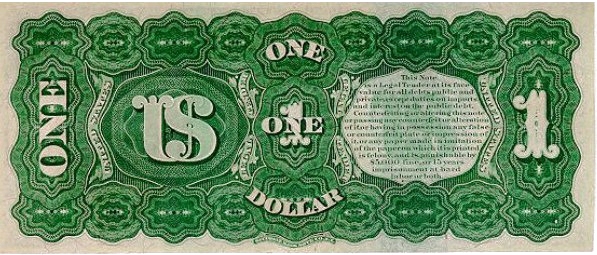 |
Soon after the establishment of the U.S. Treasury, there were both gold and silver standards used as a basis for money exchange both within the United States and between them and other world economic powers. Until the Civil War, the government prescribed ratio of the value between gold (used for large transactions) and silver (used for common money) at 15 to 1, was changed soon after the Civil War to a 16 to 1 ratio. A post-Civil War group called the
Greenbacks advocated for controlled inflation through the introduction of paper money into the American economy, deeming that it be backed by a minimum gold reserve, which was eventually set at $100 million. Others wanted the less risky and more tangible silver. The Greenback dollars were eventually guaranteed by the Federal Reserve, but starting in 1878 the U.S. government began to purchase more silver for use in coinage, carefully keeping that 16 to 1 ratio in terms of gold and silver coin content per value.
The
Bland-Allison Act of 1878 that allowed the purchase at the 16 to 1 gold/silver ratio had been vetoed by
President Rutherford B. Hayes who warned that maintaining such a high ratio of minting would quickly overvalue silver and force gold out of circulation.
An example of Silver-based currency.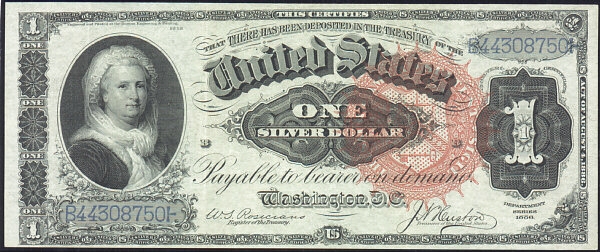 |
An increase in popular demand for the white metal resulted in an override, and the purchasing began in large quantities. In 1890, the
Sherman Silver Purchase Act was passed which mandated a doubling of the quantity of silver purchased, intended to back up an increase in circulated paper money, the first Treasury notes. While this was good for silver producers, it was inevitable that things might collapse. This was in part due to the rest of the world leaning more towards a gold standard. This further depreciated silver down to a 30 to 1 ratio of gold value, which meant the U.S. Government was overpaying for it by as much as 100%. the international exchange rate of silver vs. gold coinage yielded vastly different results for coins of allegedly the same value. In short, the amount of silver in a dollar based on that 16 to 1 content ratio was actually worth around 50¢ in 1891. The overpayment for this metal that was becoming increasingly common created false inflation in the United States, a condition that is usually followed by economic downturn.
Early in 1893, banks were suffering as a result of investments in railroads, iron ores, and other commodities that had sharply dropped in value.
An example of Gold-based currency.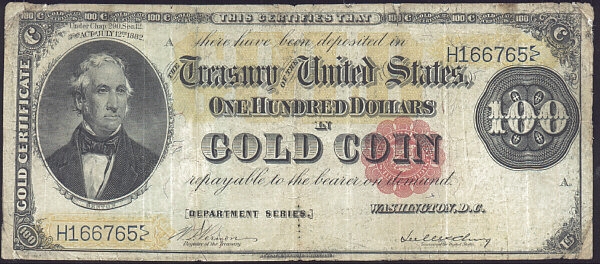 |
The U.S. Government's gold supply, still in reserve for greenbacks, was dropping rapidly, and by April it fell below the mandated $100 million minimum value. Since the government appeared to be unable to back currency effectively, banks began calling in questionable loans. On May 3, 1893, the stock market started plummeting, and a national panic began over the following days. Many banks began to fold as once stable companies found themselves unable to pay their debts. Starting in late June, President
Grover Cleveland called for a repeal of the
Sherman Silver Purchase Act of 1890, advocating that silver purchases should cease and nothing would replace these acquisitions. He eventually had his way in October when both houses of Congress repealed the act. While instantly creating a devaluation of most of the nation's currency in circulation, it helped to eliminate the false value of U.S. silver dollars, and a partial economic recovery was clearly noticeable within four years. For many, however, it was as if the $20 they had in their pocket one day was suddenly worth around $2 the next day, which created a huge drop in consumer confidence and all but necessary spending.
Typical 19th century American polka.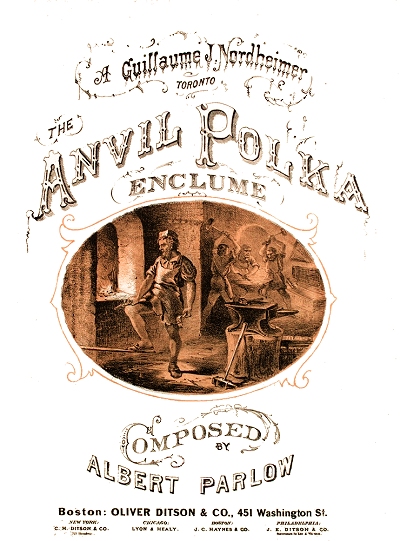 |
In reality, calling the music publishing business an
industry was laughable at best, even though it had a history traceable as far back as the 1790s in the United States. It took a lot of effort, risk, and true love of the craft of publishing and editing music to maintain a business, along with an acumen that many musicians did not possess. As a result, a plethora of partnerships between family members or friends who had different skill sets grew out of the need for sound business ability. Then there were issues with obtaining music content to print, much less new compositions, and the process of getting that music circulated to the public at large. Typesetting or engraving was time consuming, as was the process of making woodcuts or lithography plates for the covers. There was also the problem of widespread distribution. Boston firms rarely saw their music distributed outside of New England, while San Francisco publishers sometimes did better business with Japanese or Russian sailors than with New York musicians due to geographical barriers. International trade for the music business in the mid-19th century was miniscule in comparison with that of other tangible goods. Very few publishing firms founded before 1880 lasted more than a decade or so, and were often overtaken and absorbed by their more prosperous competitors.
One must wonder if a publisher often answered the question, "How can I sell more music?" with, "I need to obtain a hit song!" In reality, there was little in the way of "hit" songs before the 1890s, and some of the most popular ones were disseminated to more than one publisher, often to the financial detriment of the composer. Even the great Stephen Foster, who was able to adapt or create American folk songs, saw very little benefit from his widespread popularity. Many of his pieces were purloined and even plagiarized, and most of his fame for his contributions came posthumously. There were a few American songs like the beautiful land-shanty Shenandoah and the dynamic Battle Hymn of the Republic that became well known across broad areas during the American Civil War and the westward expansion that followed it. But even these were circulated largely through performance and not through sheet music sales.
Music performance was also hardly the lucrative field it has now become into the 21st century, largely due to digital distribution and more equal access to the world at large. Performers of the past often had few other skills, such as farming or an apprenticed trade, so they depended largely on their ability as musicians, actors or promoters to mete out a perilous standard of living at best. Most of the local variety shows in the United States before the 1880s were itinerant in nature, with troupes traveling through regions looking for adequate venues to perform in - even settling for outdoors or setting up tents on many occasions. Admission prices in ratio to incomes of the time were rather insignificant, but the opportunities for attending so-called "professional" entertainment events in much of rural America through the middle of the 19th century were rare, so most everybody in town would take advantage of them. There was rarely any personal money actually budgeted for entertainment except among the middle and upper class population in the larger towns and cities. Also, many entertainers used their own material, and unless they had seen to publishing it for sale at their shows, the tunes would often disappear as soon as the troupe left town.
Advances in metallurgy and printing technology helped to reduce the cost of publishing in general, and advantageously so in terms of quantity of output. The advent of the transcontinental rail lines along with a better overall local transportation network helped some publications see wider circulation. But even in the mid-1880s, the time had not come when entertainment was seen as more than some scurrilous occupation by those in more tangible trades, or for the composers and publishers of music to penetrate rapidly into the American home with tunes that resounded through the heads of their occupants. This was all about to change.
One of the obvious factors that created the financial panic situation in 1893 was overbearing government intervention. Another less evident cause was the nature of businesses that were driving the economy in the late 19th century. It is clear why this time period was labeled
The Industrial Age, as most of the major investments were in railroads, ores and coal, steel and other building materials, and lining politician's pockets by the industrial leaders
(as evidenced by the Tammany Hall scandal in New York City). The American worker was valued for their work ethic, but little consideration seemed to be given to their leisure time.
The first true million-selling song, After the Ball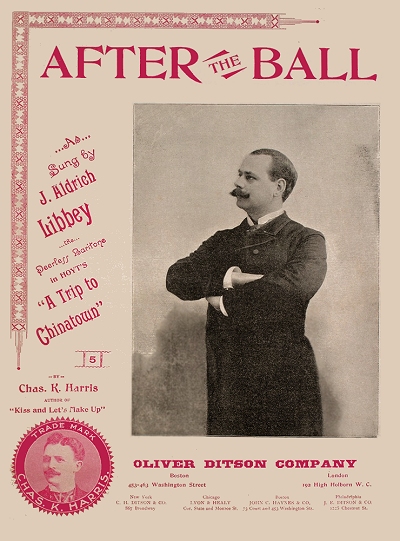 |
This was more so for family leisure time outside of the home, since those public forms of recreation and entertainment that did exist were usually geared toward men in what was still a male-dominated society. This misogynistic attitude would change radically between 1895 and 1915. A changeover between the industrial conglomerates and the entertainment field was taking place, and in many ways they fueled each other.
The music of the early 1890s seemed to match the mood of the country in general. There were many thoroughly depressing tear-jerker ballads both produced and performed, and what little popular music aside from those that was getting notoriety were what would be soon known as "coon" songs. An example of the most famous of these tearjerkers from 1893 is
The Fatal Wedding by
Gussie Davis and
William Windom. It vividly describes a wedding ceremony at which the groom's former lover shows up with his illegitimate baby in the throes of death. He proceeds to kill himself in front of the guests, whereas the child dies shortly thereafter. The bride takes responsibility for the future of the mother of her now deceased groom's child, and as they plan to live together the whole situation makes
Hamlet look rather tame. But this was what was selling at that time. The first piece of what can now be termed as truly "Popular Music" was
After the Ball by
Charles K. Harris.
Little Egypt does her thing at the Chicago Columbian Exhibition.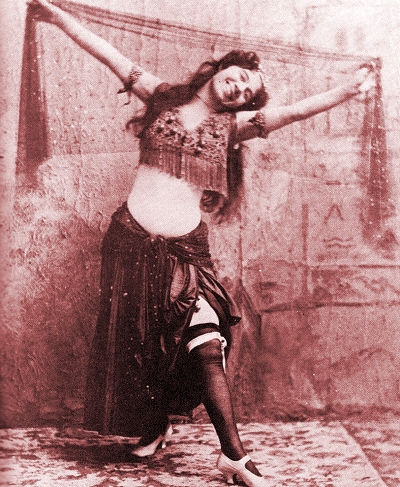 |
Written in 1888, it took it more than a decade to reach the million copy milestone, but it was the first song to ever top that mark whereas its predecessors rarely saw anything approaching 100,000 copies. During the decade of the 1890s popular music experienced an extraordinary level of change, much of which reflected changing trends in society, but some of which actually set new trends.
It was in the summer of 1893 that Ragtime was first reportedly heard, played either at the Chicago Columbian Exhibition or in some of the many venues surrounding the fair. It is also possible that this is where the great Scott Joplin initially encountered the music that would be his calling for the rest of his life. While the Ferris Wheel and belly dancer Little Egypt got the bulk of publicity at the event, visiting musicians were paying attention to this new style of syncopated piano playing. Many of them were the pioneers that took this raw form of the music and helped make it more palatable and easier to publish. By 1897, the term "rag-time", had been coined, and syncopation was starting to appear everywhere. The term would soon be concatenated into "ragtime." By the turn of the 20th century in 1901, cakewalks, "coon" songs, marches, piano rags, and other popular song forms were quickly overtaking the maudlin ballads of the prior decade in both sales and performance frequency. While the majority of piano rags would see only regional distribution, Tin Pan Alley in New York City would soon prove to be a major factor in music production, and a much expanded and in many ways new industry was underway, experiencing previously unparalleled exponential growth into the 1920s.
It is rare that the growth of one industry does not cross over or trickle-down into others. The burgeoning world of music publishing and performance in the early 20th century provides a vivid example of this, and suggests a unique business paradigm as well. It was a fortuitous opportunity when initial demand was growing well beyond supply, but the changeover in the American economy was helping create a supply of workers who soon fueled the demand. As they are involved in a diverse number of industries in varying capacities, we will try to break down the distribution of supply in terms of each product, noting crossover where it exists. While not every minute facet of the great network that supported popular music creation and performance can be explored in this space, the general idea of how far reaching it actually was will hopefully be evident.
A rare First Edition of the Maple Leaf Rag.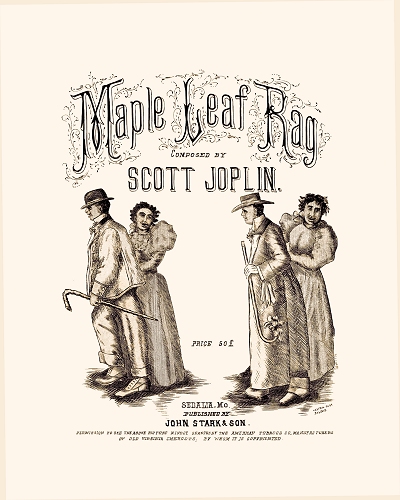 |
SHEET MUSIC: Existing publishers, some dedicated to music and others who published in multiple media, started working at a furious pace in the late 1890s to keep up with increasing sales, and many new publishing firms were created as well, although a number of them were ultimately short-lived. While older established publishing houses were able to branch out into many divisions representing various genres of music, many were more focused on trends or other market niches. For a great deal of the Ragtime era (1896 to 1918), the majority of composers of rags, songs, waltzes, etc. sold their pieces outright to a publisher. While Scott Joplin did secure a royalty for the sale of many of his pieces, the most notable being his
Maple Leaf Rag of 1899, this was a rare situation for its time, even more so for women or composers of color. It was often harder for a black composer to obtain royalties than his white peers, although many white composers faced the same issue. Their instant payoff for selling a piece was quickly absorbed into the local economy, which motivated them to write even more. In many cases the publisher would reap benefits amounting to hundreds of times of what the initial acquisition cost them, while the musician still had to scramble to make a living. Therefore, the publishers had the capital they needed for expansion and promotion. One other suspect scheme was that of the crop of song-poem companies that sprang up in the early 1900s, offering to print pretty much anything they received, as long as it was paid for by the composer, who was then responsible for distribution. Many were shut down by the Department of Treasury or the United States Post Office for defrauding the public through the U.S. mail. Several regional and local firms acted simply as jobbers that facilitated vanity publications with no malice or fraud intended. In spite of the drawbacks, many of them contributed to the placement of printed music into remote localities that often saw their town composer, male or female, black or white, as somewhat of a celebrity.
However, to meet the increasing demand for sheet music, it was the expansion in this field that was a large key to fueling the economy.
A rolling machine at an early paper mill.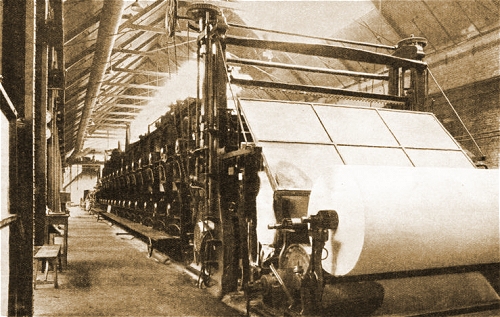 |
Paper mills, fed by the lumber industry, had to increase production of their better grades of stock. This also applied to paper used for newspapers as the population as a whole was becoming increasingly literate and reading more. Telephony also allowed for global news stories to be reported on immediately, which added to the number of stories and the size of the newspapers. But the paper used for sheet music had to be much more durable, and therefore created a higher profit margin for the mills, as well as a need for more employees. This demand also applied to the ink producers, which were fed by both farming and petroleum, the latter being an industry that was, itself, about to experience an unprecedented boom. Then there was the metal needed for the printing plates, at least 50 times more in 1904 than was needed in 1894. The printing presses were always in need of menial workers who could run the machinery, but musical experience was required to produce the note engraving and typesetting for the plates. The number of employed professional artists in the United States rose dramatically as publishers started to utilize colorful and catchy artwork for their sheet music covers. Some of the top artists could command as much or more for their covers as the composer did for the contents within the pages, largely because their work acted as both identification and advertising for the piece. While many publishers were still regional, and a number of them only sold their product in a company store that was often on the same premises as the printing press, the printed music still needed to be transported to other businesses that would sell it. The railroad industry as well as early motor truck drivers certainly benefited from this increase in shipping traffic.
SALES AND DISTRIBUTION: Printing the music was one thing. However, getting it into the stores and eventually into the hands of the eager buying public was quite another. One position that had existed in many publishing house and was now gaining prominence was that of the music salesman. But the parameters of that job were changing as well. Whereas in the past it was often a musician that took this position (a necessity to demonstrate songs), the qualifications for such employment were transitioning towards those with a higher balance of business acumen. They also needed to be able to sell the song to popular performers, sometimes backstage between shows. This was clearly not a job for a female player, as it meant late night visits to theaters, which was considered inappropriate by many. And while music stores were opening at a record rate in the early 1900s, non-music stores, such as Woolworth's or Wanamakers, were now taking on popular sheet music as part of their cornucopia of dry goods. This often meant employment of a pianist to demonstrate songs or rags right in the store. Even though there were a large number of male pianists in the United States, they were often working in other day jobs, or not available or amenable to such a position. As a result, it was the female, who was most often the member of the American family likely to have had some formal piano instruction, who filled these positions. This was a new direction in American culture, as previously most women were either homemakers or had worked in sweatshop environments. Now those that were pianists could be independent wage earners (although still extremely disparate from men's pay scales) who could also shine as one person rather than as part of a group of mass laborers.
Another increasingly effective mode of distribution and promotion was that of celebrity endorsement.
Al Jolson - "The World's Greatest Entertainer" |
Sophie Tucker - "Last of the Red Hot Mammas" |
While this became much more prevalent in the 1910s with dominant personalities such as
Nora Bayes,
Sophie Tucker and
Al Jolson, the temporary inclusion of a popular song into one of the dinner or evening shows at a local theater was considered to be a great sales pitch as well. This was often reinforced with copies of the music for sale in the lobby of the theater after the performance. Small towns throughout the United States were provided with lyric and picture slides for the latest tunes, which were sung in the local cinema or town hall while the projectionist was changing reels on their single projector. The house usually got some of the take from post-show lobby sales. There were also write-ups in the newspapers from time to time, which were considered free publicity, regardless of the nature of the review. So this sold more papers, induced the venue owners to get the best possible shows within their budget, employed more people to pitch and sell the songs, and created a supply of new entertainment for a demanding public. The growth of cinemas, dramatic theaters and vaudeville venues grew exponentially between 1895 and 1910, driving many local economies where the capital was sorely needed. There were even a few companies that sprang up explicitly to design and build customized theaters throughout the country, albeit using a cookie-cutter design paradigm.
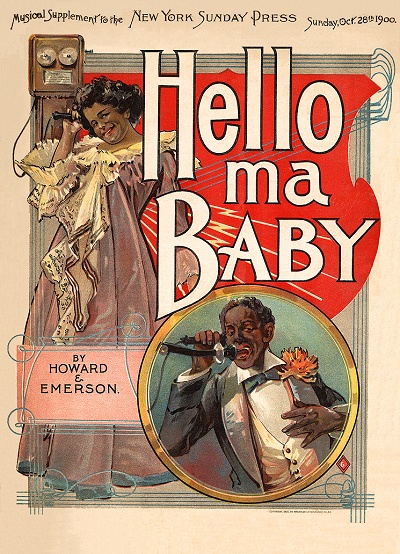
Other marketing methods to get music into homes cannot be ignored. The publication of music-oriented magazines, both popular and classical, as well as distribution of select pieces such as
Hello Ma Baby as Sunday newspaper supplements went a long way toward putting ragtime in as many homes as possible, creating a thirst for more of it. Catalogs of music libraries were routinely sent out, some via a parcel post spread, usually for free. General magazines also sometimes had supplements, and most had prominent advertisements for music with some catchy samples, or for piano rolls and hardware to play them, much in the way that televisions would dominate magazines of the 1950s and 1960s. Even basic businesses like Woolworths Five and Dime stores added music departments and demonstrators to staff them, as did most of the fancier department stores around the country. Select pieces would be heavily discounted as loss-leaders in order to gain foot traffic in the retail spaces to encourage the purchase of the more popular hit songs. In these ways popular music helped propagate itself into its own popularity, albeit with a lot more effort than by radio, which would eventually be the most viable and widespread conduit. To some extent, for the first time in American society, the public was ostensibly being told what was popular (and sometimes what was not), although that ploy clearly did not always succeed.
PIANOS: In addition to the burgeoning sheet music industry, other facets of the economy saw clear gains due to renewed consumer confidence by 1898, and the desire to bring broader entertainment and leisure into the American home. Of course to play most music in the home for frequent family gatherings, a required piece of furniture was the piano.
Starr Piano and Organ Factory in Richmond, Indiana around 1909, one of many manufacturers that sprang up to meet consumer demand.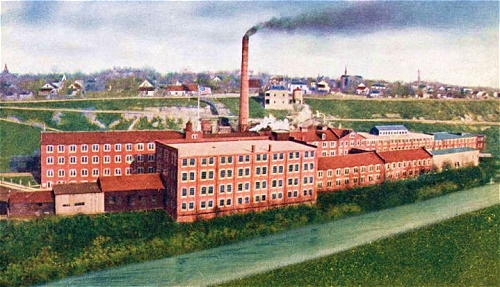 |
Sales of all manner of pianos soared consistently over the ensuing three decades, not to peak until 1927. This meant more business for lumber mills, providing wood for the cases and action parts, and even the shipping containers; steel mills, crafting screws, bolts, cast-iron plates, and piano strings, some of which also required copper windings around them; as well as trained technicians, salesmen, piano instructors, and those who wrote courses for playing popular piano styles. The most enterprising of these was Chicago entrepreneur
Axel Christensen, who took the approach of improving the musical "98 pound weakling," turning many students around the country into alleged piano strongmen or women, and collecting a fortune along the way. But the demographics of sales and the continuing desire to improve sounds brought changes to the construction of the piano as well. By 1918, the international standard pitch of A=435 cycles had been raised to A=440, adopted in the United States a few years prior. This added up to two tons of tension to a tuned instrument that already exceeded twelve tons of stress, necessitating changes in pinblock design, frame strength, and the size of the cast iron plate. The short-lived square grand piano did not cope well with these advances, and had all but disappeared from the marketplace by 1900. But upright pianos were made in large quantities, and were soon readily available to any citizen who had access to a Sears and Roebuck or Montgomery Ward catalog, even buying an instrument on the installment plan. It was actually a combination of automobile and piano sales that helped foster the system of consumer credit that is now a staple of society. One could even order a house kit from a catalog to build around their instrument, creating a comfy and cultured domicile on a budget.
But many American consumers had neither the time nor the inclination
So easy a child could pump it. Early Gulbransen Player Piano advertisement.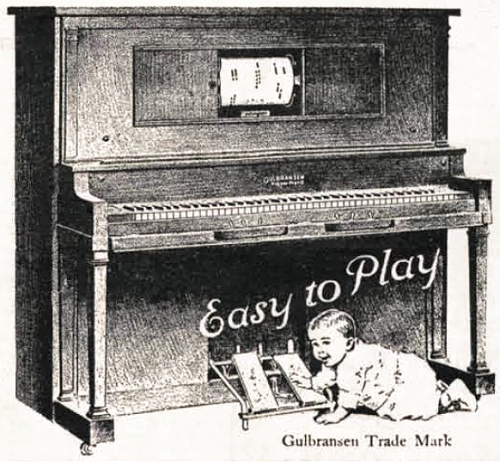 |
to learn how to play the piano, or at least where they were comfortable with their abilities. The piano had become a status symbol, but was too often ignored once frustrating efforts had been made to master it, then abandoned. Knowing this, several attempts had been made since the 1850s to produce an automated piano. By 1900 a few push-up 65 note roll models were available that would actually press down on the piano keys as they were pumped. Within four years, pianos with internal player devices were available. Before the decade was out, many instruments were electrified, played 80 to 88 notes, and even allowed the introduction of expression into a performance. This concept grew into devices that played a variety of percussion, wind and stringed instruments in addition to the piano, all from a programmed roll. It was a boon for the consumer who desired music in the home without the requisite effort and the business owner who wanted low-cost entertainment during daytime hours that paid for itself. A whole new industry creating vacuum-controlled pneumatic units for placement in pianos that could be easily modified by nearly any existing manufacturer was born, and it thrived for a quarter of a century. And of course there was always a need for software, so musicians often found extra employment arranging piano rolls. The crossover into phonograph records of piano-oriented music did not really occur until the early 1920s.
Coors Brewery in Golden,
Colorado, a definite
stimulus to the local economy.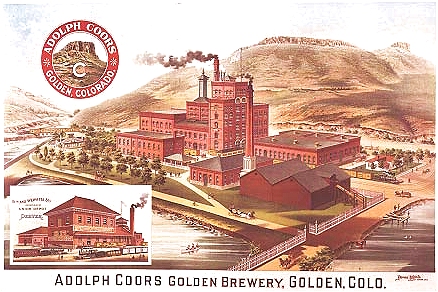 |
ALCOHOL: While many Americans did consume some alcohol at home, prior to the 20th century it was often produced by them or a neighbor in a still. Packaging of liquor for take-out consumption was still rather expensive, and the liquor industry was largely unregulated as well. So by 1901, many more people were inclined to participate in social drinking. In order to bring customers into a drinking or eating establishment in the days before "Happy Hours" were common, free lunches and entertainment were both utilized as a major draw. Between watering down of drinks and pricing alcohol at inflated levels, profit margins on liquor sales were appreciable. In addition, more young people were leaving the farms for careers in the city, and the average age of the drinking population was slowly decreasing. It became a challenge for the distilleries to keep up with the steadily increasing demand. This trickled down to farmers who were doing great business in grains and corn. It also led to some of the first large buyouts of family farms by companies such as
Anheuser Busch and
Adolph Coors, creating an early version of the corporate farm, a trend that became more prevalent in the 1950s with the advent of the supermarket.
Ragtime and liquor seemed to go together well, and this combination was an experience afforded to the many millions of visitors to the 1904 Louisiana Purchase Exposition, also known as the 1904 Saint Louis [Missouri] World's Fair, with its many venues offering both. The musicians themselves imbibed in more than just alcohol, acquiring dependencies on some of the variety of opiates readily available before the advent of the U.S. Food and Drug Administration and the Pure Food and Drugs Act of 1906. The musicians often introduced select members of their audiences to a cornucopia of drugs as well. Once these substances were made illegal, a black market was formed where these narcotics were still available, but at inflated prices. Addictions being what they are, business was good and the economy was still driven from within this diabolical cycle. In fact, it was the abuse and addiction of alcohol that contributed to one of the underground's greatest economic boons - the Prohibition of Alcohol in the United States instituted in 1920 in the form of the 18th amendment to the Constitution and the dreaded Volstead Act. Opium dens were still in operation, but now the Speakeasy was added to the mix, and many musicians could command even higher wages working in these venues, given the potential risk of raids by law enforcement, when they cared to do so. In addition, addiction and detox units were proliferating by necessity in American hospitals, creating more trained staff positions as well as state and local government subsidies. No matter what the money went for, it all trickled back into the economy somehow.
OTHER RECREATION:Glen Echo Park near Washington, D.C., one of many trolley parks where Ragtime could be heard played by orchestras.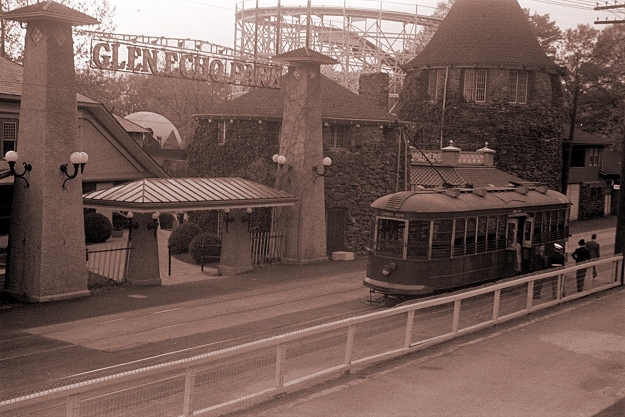 |
Whereas leisure time recreation had not been a huge business in pre-Ragtime years, suddenly Americans were getting a taste for it and demanding more. Entirely new forms of entertainment started to emerge. Beer gardens, some of which had featured mild roller coasters known as "scenic railways," started promoting family trips to their parks on the weekends. By inventing and adding new ride attractions, ranging from Carousels and Ferris Wheels to Steeplechase rides, they started to draw a younger American population that seemed to have some disposable income for the first time. They also tended to hire young adults to operate these rides for what evolved into the traditional Amusement Park. While the national main-line railroads were waning in popularity, mass transit in the form of trolley cars was rapidly gaining favor, and many cities had a trolley line that ended at one of these establishments, sometimes owned and operated by the line itself. They were typically designated as Trolley Parks, due to their ownership and location. Musical entertainment was also prevalent in this business, utilizing everyone from dancers to calliope players. Where there was virtually no industry in this regard in 1890, it was thriving substantially before even two decades had passed. Many fine composers and performers of ragtime and popular music got their start playing at such establishments.
Around the same time as the coin operated mechanical music devices were placed in public venues, so were machines that when cranked would spin a series of small photographs around in a specific sequence,
A scene of a film within a film, showing the pianist hardly at work at an upright. Many used elaborate organs or player pianos.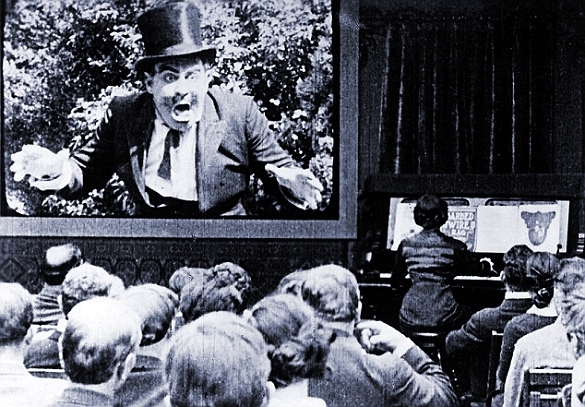 |
giving the illusion of motion. These nickelodeon devices were the precursor of the modern cinema or movie theater, a business that did not even exist in 1900, but for which many grand palaces had been constructed before even the mid-1910s. And with those movie palaces there was a need, in many cases driven by an edict from the production companies or filmmakers themselves, for music to accompany the films. Some of them, including
D.W. Griffith, had scores written for their films, as well as piano reductions, and some filmmakers like
Charles Chaplin wrote or suggested their own musical cues which were distributed with their films. Elaborate multi-keyboard mega-stop organs were routinely placed in the best theaters throughout the country, and a musician who knew how to use these devices properly and displayed an innate ability to effectively enhance the screen action with sound effects and music could command princely sums for the run of a film series, or ever permanently. In small towns across America, the local piano teacher or one or more of their students were routinely given employment playing for films. Some music publishers managed to become relevant in the field by issuing books of "photoplay music," containing specific cues written in a variety of styles to match nearly any situation presented on screen. Even for a nickel or dime admission, the construction and operation of film venues was a lucrative business up through the late 1920s, and one that kept a plethora of musicians gainfully employed for quite some time.
It has been often noted that carnal recreation has never gone out of style. That being said, the "
red light" districts (red lights were literally used to highlight their location in many locales)
An alluring lady of Storyville in
New Orleans, around 1910, taken
by Ernest Bellocq.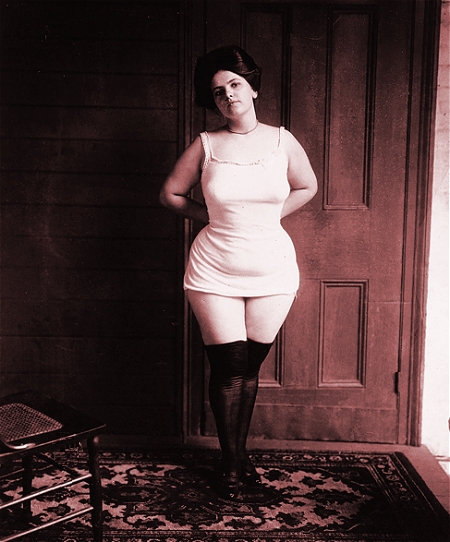 |
and houses of prostitution started doing better business than ever with the advent of Ragtime. Many madams saw to it that their establishments were lavishly decorated, and always had a Ragtime pianist at the ready for the girls to come down and do their dance for potential customers. There have been a couple of stories [unsubstantiated but intriguing] that the very name of Ragtime comes from a pianist in the back room playing for the girls temporarily off duty because it was their "rag time." Some cities zoned specific areas where prostitution was either legal or simply tolerated. The most well-known of these was the Storyville district in New Orleans, Louisiana, laid out by alderman
Sidney Story, and legally created by ordaining prostitution as illegal throughout the city outside of a sixteen block area, without actually making it legal within that zone. Some districts enjoyed a level of fame, including Twelfth Street in Kansas City, Missouri, which may have helped to give
Euday Bowman's long-lasting hit
12th Street Rag its title. There was a great deal of crossover between the brothels and alcohol-serving venues providing musical entertainment, and much redistribution of their combined wealth as well. The owners did, after all, pay taxes, occasionally more than was required by neighboring businesses. As with alcohol, this was an aspect of the economy that started to suffer from its own success and excess, and idiosyncratic changes in public morality saw the houses and the surrounding districts shut down around the advent of Prohibition in 1920. This moral turn is ironic in the face of the flirtatious and sexually promiscuous attitudes of the 1920s. The loss of controlled prostitution actually turned out to be a blow to many local economies as the professionals were either out on their own now or found some form of representation. In such a situation, they were less accountable for tax dollars and could more easily retain a larger portion of their income, often keeping it out of circulation.






 Loading Page. Please Wait...

 Player Pianos
 Ragtime & the Economy



 Click here for more space
  Click here to expand menu